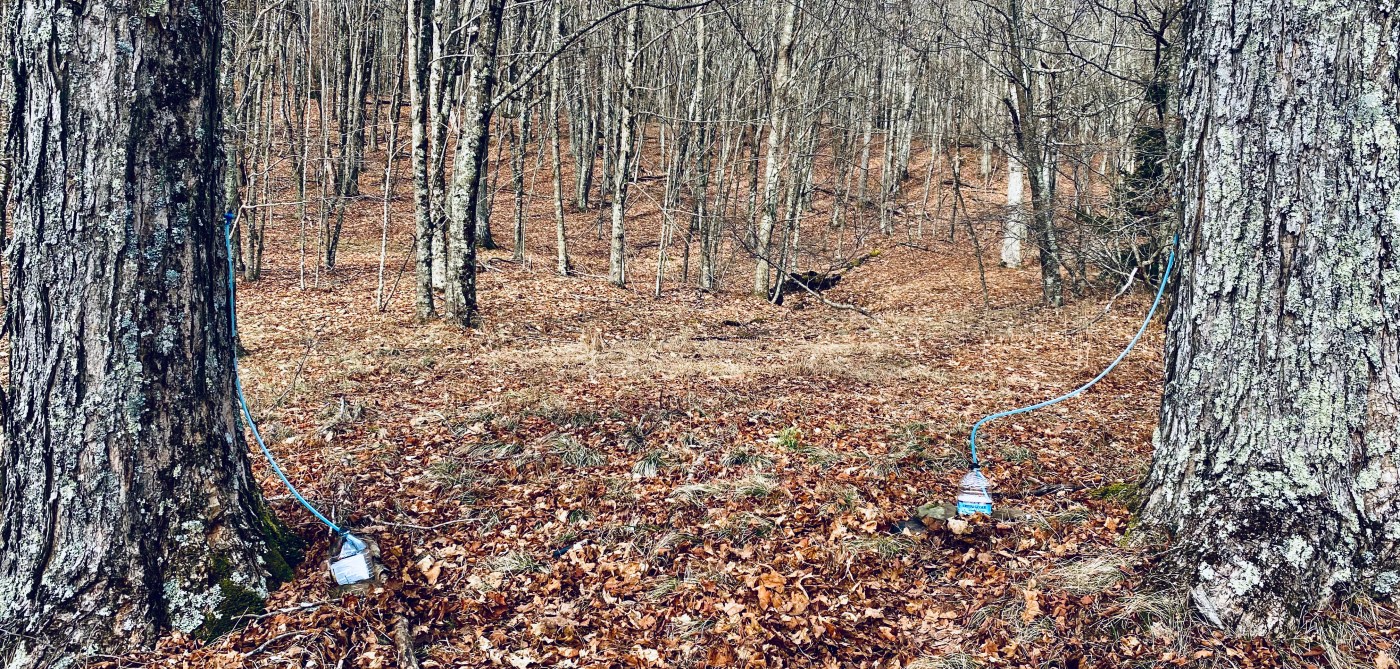
48 drips per minute. The sugar water fills a bucket, pulled upwards from root storage in mid-winter. A single tap, in an approximately 1/2 inch hole, is one pin-prick in the girth of this ancestor maple. These two that I have tapped are far older and far wiser than I. I have no idea whether they are a she or he but I see these as female, for the obvious reasons. Apparently individual sugar maples can be both sexes or one or the other. Both sexes are required for reproduction, along with countless other allies in the form of breezes, insects and, often, animals. Each tree seems to be able to be more fluid with how they want to represent themselves sexually and with whom they may eventually entangle their genetics.
Sugar maples pull up such abundance of their life nourishing winter sugar stores that humans may honorably harvest a percent of that. I don’t want to assume that this doesn’t hurt the tree. It likely does. Is this the corollary of exsanguination for trees? At what rate will the tree lose its vitality? What does she feel about our new relationship?
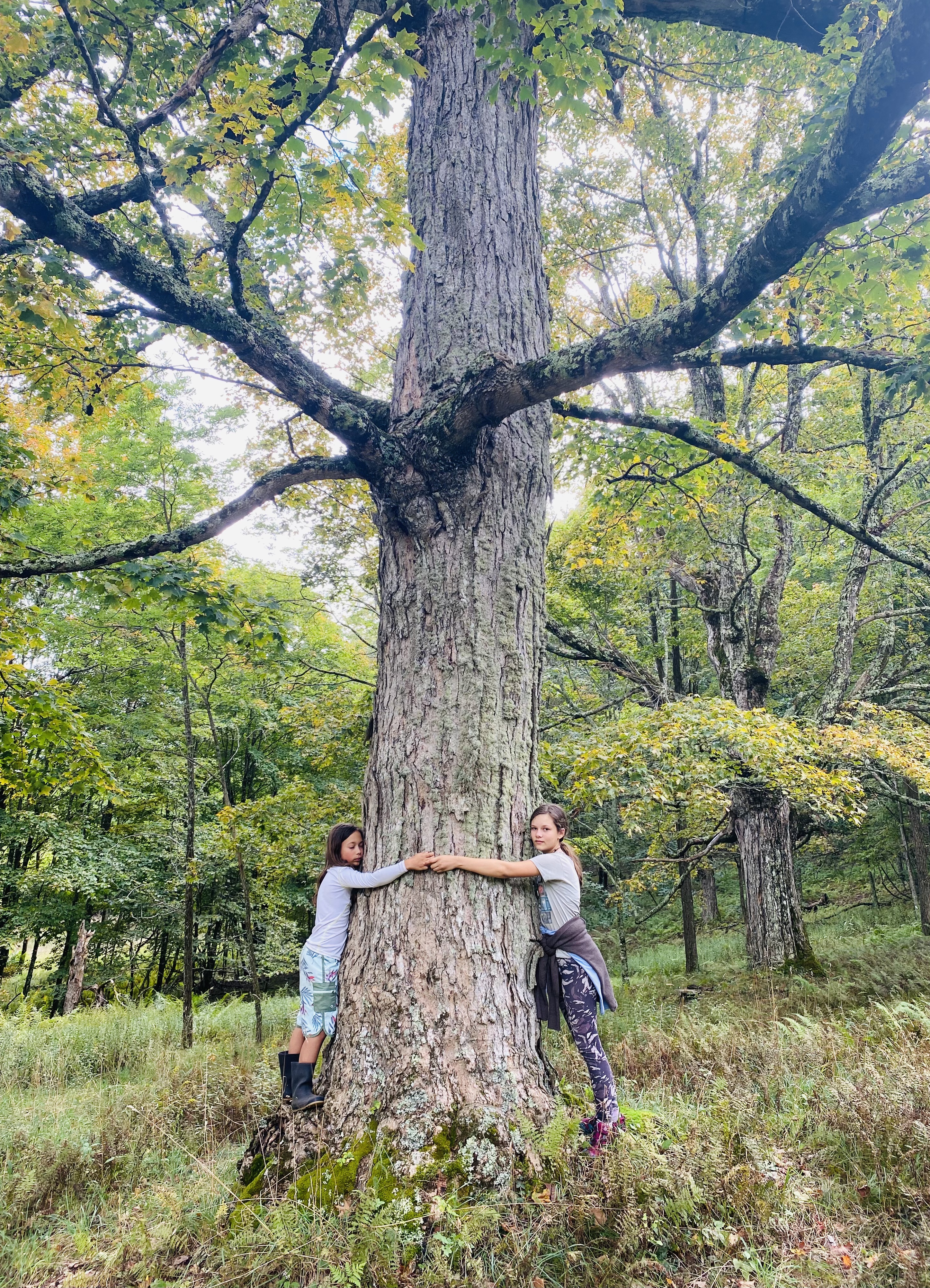
As beings within the animal kingdom, humans are life consumers; we are unable to produce the means of our sustenance from the elements of air, water, and soil. We are also accustomed to thinking that by taking from another being we are in some way harming them. As modern humans that have overextended our taking by incomprehensible sums as we cause immense harm, this is understandable and accurate. Yet in this case, on this small, honorable scale, may we also imagine that this glorious old maple tree enjoys sharing her abundance? Let us at least consider this possibility for a bit.
What is creation but the sharing of excess life and energy? The generous humans I know are filled with love and joy when they can offer their abundant gifts to the world. I would believe the same may be true for our maple kin as well. There may even be pulses of joy in this Acer saccharum as she fills our bucket. What is the anatomy of joy in an organism? Where does it live, and how is it sensed, and why does it arise? Considering that our nervous systems are mostly modeled around the same principles as a tree’s physical form, we realize that very few things are unique to humans. In honoring the reciprocal joy of giving and receiving, we can see that a “leave no trace” ethic of interaction with the world misses alot. It misses the reality that there is joy in the giving, and even in allowing ourselves to be altered by one another – human and more-than-human, leaving traces on each other all the time. Giving parts of ourselves, even giving our own life blood is always the way of life and of belonging. There is loss and potential harm in the giving. Eventually we give completely in death. But there is definitely no life without it.
In his book Long Life, Honey in the Heart, Martin Prechtel tells a story of the humble moment when he realized he needed to become indebted to his fellow community members in Santiago Atitlan, Guatemala. He came up short with funds he needed to host a ceremony and had to borrow from his neighbors. Yet he vowed to repay the debts as quickly as he could. After the ceremony, he worked to gather money to pay off the debts. The day came for him to go house to house in order to balance the accounts. In house after house he was yelled at and chased out before he realized that they didn’t want him to pay back the debt. By him trying to balance the accounting, the community felt like he was readying himself to leave, and he no longer belonged. Belonging in community requires continual, mutual indebtedness.
So it is with our more-than-human kin as well. When we aim to do no harm, leave no trace, have no impact, to extract no nourishment, we are both deceiving ourselves, while also severing this important thread of belonging. We find ourselves in a postmodern, deconstructed pile of frayed relationships rather than a sturdy entanglement of mutual indebtedness. Don’t we feel this in our human relationships too? Do we not care most for those that we perpetually take from? Or those that take the most from us? Those we give the most to? Those with whom we’re in this mess together? Entangled. When meditating on impermanence, there is a truth to non-attachment. Yet this is quite a different point of focus than the truth of mutual entanglement. Mutual entanglement is even distinct from interconnectedness. From a Buddhist lens, it is more like conditioned co-arising, or intraconnectedness, as Daniel Siegel puts forth in Intraconnected.
Once the process of taking is tied to the nearly universal modern profit imperative, the relationship nearly always becomes exploitative. At the very least it becomes transactional. So it is with the maples. There are dangers to the point I am making about maples. It is likely that the modern maple tapping industry is harming the trees and the forest. This is certainly true of every other agricultural sector.
No amount of math can define an honorable harvest, yet with some important guiding principles I think we tend to know whether the reciprocal giving and receiving is in balance. I think we know it in our hearts, which typically beat only slightly more than this maple’s current 48 drips per minute.
In some ways, when the sugar maple trees are no longer tapped, I wonder whether the tree will be cared for and find a place in an uncertain future of these temperate forests. By taking from the trees, and by the trees offering their nourishment, both species (and likely many others) flourish. If we allow for this entanglement, the sugar water can continue to run. Only when we allow ourselves emotionally and physically to be entangled can we truly belong. By choosing to have a relationship with a sugar maple tree, one that even may inflict harm but also could possibly bring the joy of gift giving, our exchange is dramatically different. When I realize that I am physically and vitally indebted to these trees, I may take this relationship more seriously. This is why I made the choice to introduce myself to the two trees, come into relationship with them, and drill into their moist, soft sapwood. To better care for them.
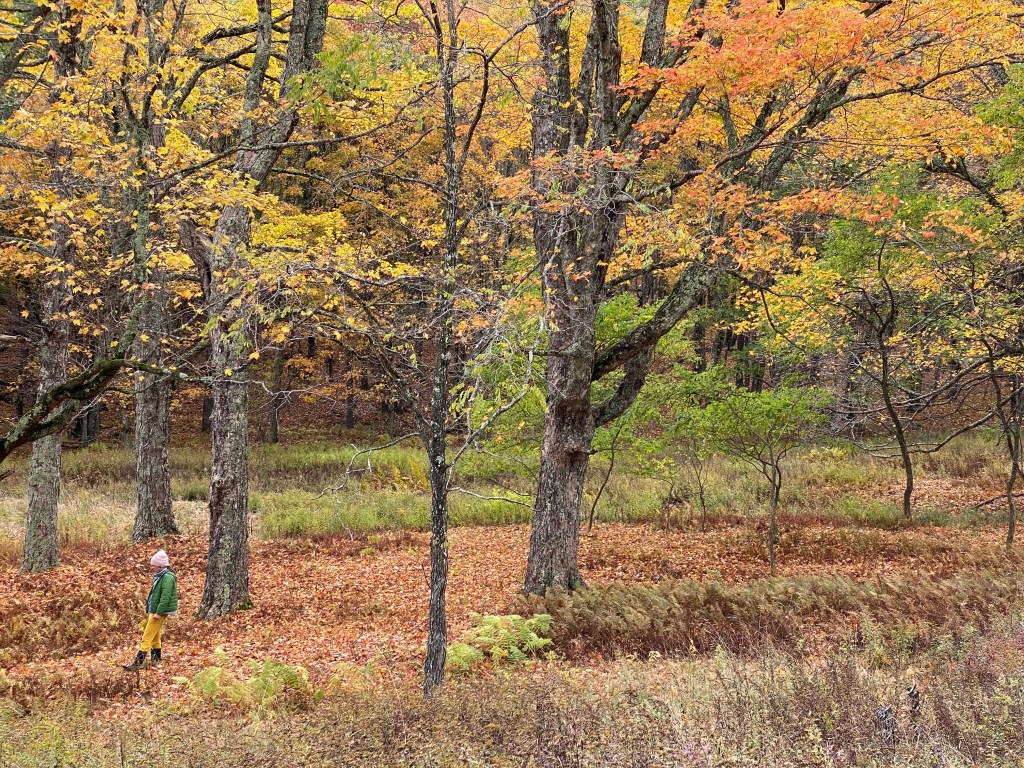
I need to be careful here again. The trees don’t need humans. If humans stopped tapping, or if humans moved away from these forests completely, the trees would continue doing their tree thing. Humans would do other things. Other species would continue to consume what the maple offers, notably fungus, insects, and birds. Maples may be better off in that scenario. But the point is not that the sugar maple trees need us, or we need them, but that we may choose to depend on each other. We can choose to tether our survival to one another. And beautiful, unexpected things may happen when we do this. Like nutritious sugar water. Like that same water thickening to maple syrup. Like Appalachian hillsides covered in fiery red leaves in the autumn. Like community.
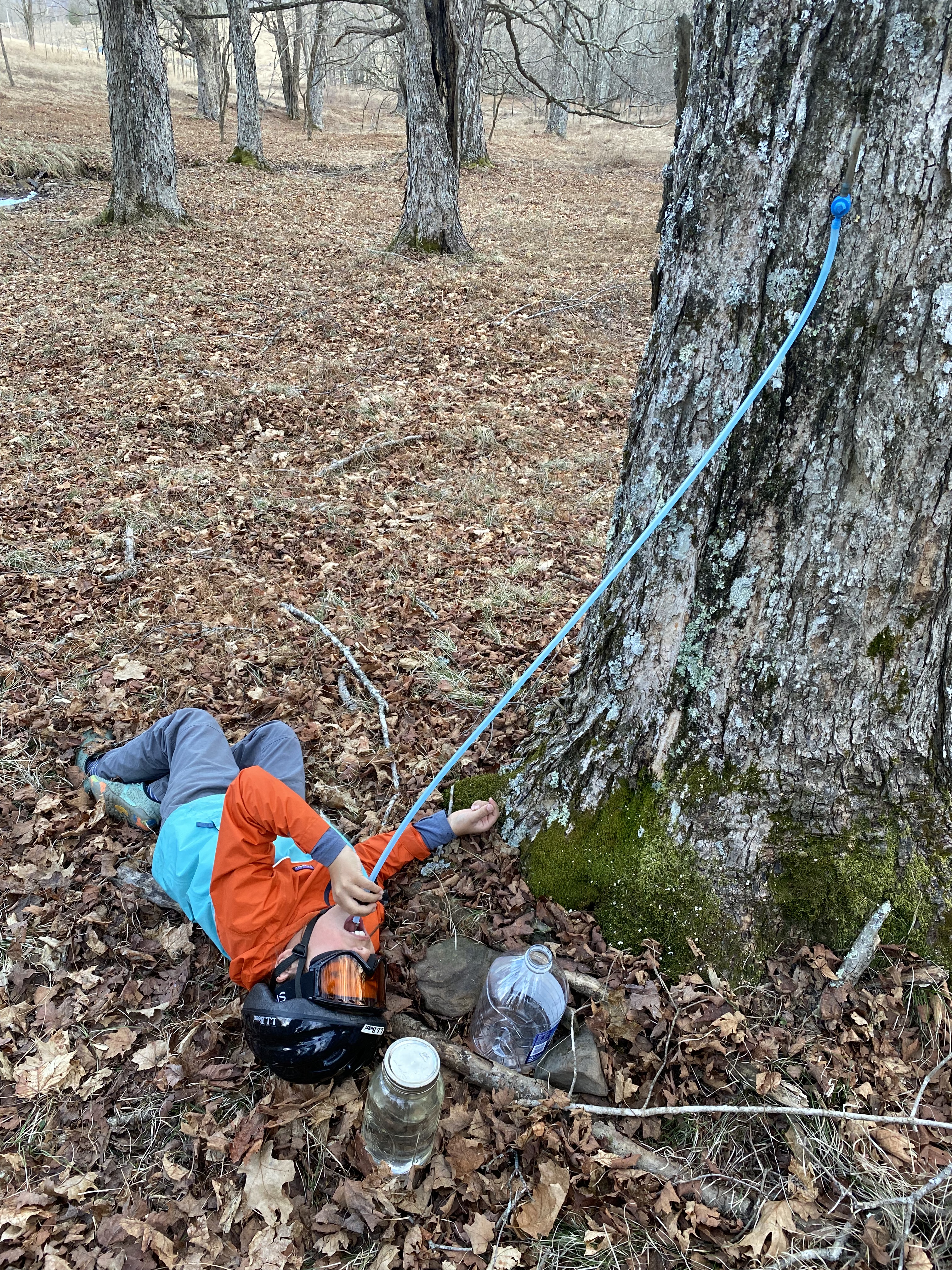
As a footnote here, Maple sugar making is an old, indigenous practice in the eastern and northern North American woodlands. We are in the season here in central Appalachia and many folks tie their livelihood and their forest relating to sugaring . I am sheepish and self-conscious even trying to write about the important of sugar maples. What can I possibly offer to this conversation that Robin Wall Kimmerer hasn’t already covered in Chapter 7 of Braiding Sweetgrass?
 Bueno Ramro
February 27, 2024 at 11:58 pm
As always, love to read your posts. Wonderful analogy and contemplation on community and exchange among all life on our planet.
LikeLike
March 4, 2024 at 12:15 am
Lots of food for thought Tim. Am still at the dinner table. When we visited those Maples with you several days ago had no idea there was so much more to consider about their story. So educational and creative in your posts!
LikeLike