by Shannon
I hear the hum through my ear plugs. I know it’s still early. The sky has not shed her final stars and the dawn chorus has yet to begin. As I press the wax deeper, I notice my breath and the rub in my nervous system. This asphalt anaconda that snakes through the Amazon is the only artery to move the essential nutrients of commerce between the lowland rainforest of Colombia to the Andean slopes and valleys that comprise the most economically and agriculturally rich region of the country. I can understand why it’s there AND the wall of sound it hurls into the airspace around it agitates the mind. It’s not just the aggressive noise that 18 wheelers make, but the knowledge that this highway has dramatically altered and fragmented what remains of the viable habitat for countless species. If you are wingless, this road at best creates an obstacle and decimates your gene pool, at worst it will be your grave.
In his most recent book Crossings: How Road Ecology is Shaping the Future of our Planet, environmental journalist Ben Goldfarb writes, “While roads are so ubiquitous they’re practically invisible to us, wild animals experience them as entirely alien forces of death and disruption.” Honestly, as we walk along it each day, bracing ourselves against its uproar, I feel like a wild animal. My nostrils flare, I cover my ears, I shrink to the shoulder and brace myself with each passing monster truck that turns up and throws waves of heat, dust, and exhaust at us. The journey along it has become some kind of bardo, with our rebirth in the sacred waters of the river that parallels it, only meters away through the lush, verdant jungle.
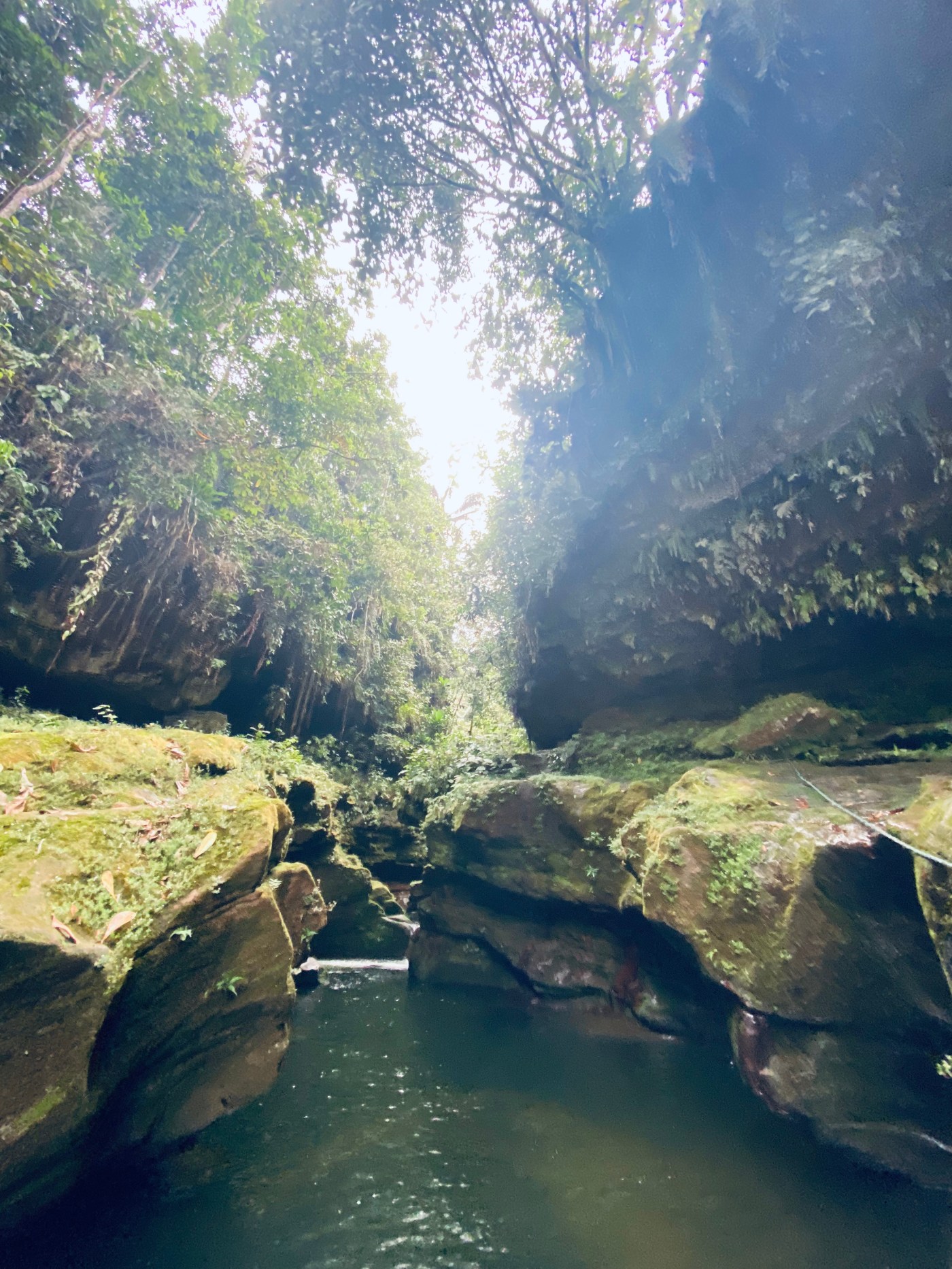
This river, the Dantayaco, tells her fluid story as she carves through rock, eventually reuniting with her sister, the wider and swifter Mocoa. For millennia, the deepening canyon has directed her flow through walls carpeted in mosses and lichens, draped in fine ferns, the canopy above a vaulted ceiling. These walls have created the perfect acoustic venue for her voice. For us it has inspired wonder and become an outlet to plug ourselves back into the Earth, to calm our internal waters. Soaking in her cool liquid is medicine. I float on my back, suspended in a primordial state – a time before the anthropocene – before urbanization, before globalization, before high speed internet, high speed humans, and high speed asphalt roads. Right now, hers is the only voice I hear, the only story that matters.
 Bueno Ramro
Leave a comment