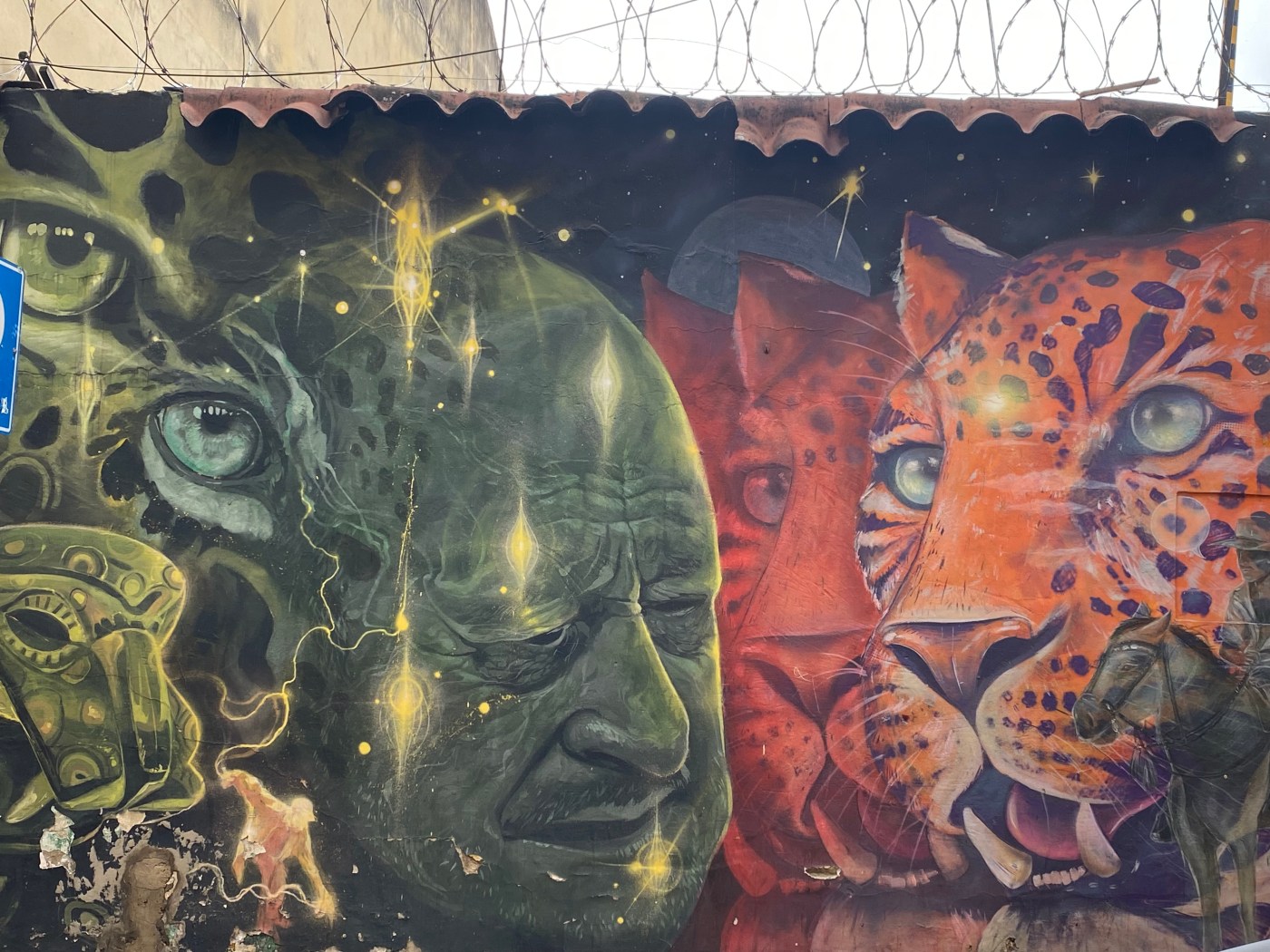
The Majestic Jaguar
by Mason
Jaguar – he who kills with one leap, the king of the jungle. I think these are fitting names for this strong, majestic creature. Jaguars have fascinating biology. They are also, sadly, threatened, with a number of reasons for their decline. In addition, they have a long and often strained relationship with human communities. Being in Colombia and seeing how important they are to the people there made me interested to learn more about them.
Jaguars are around 170 centimeters long, not including their tail. Because of all this body mass, they weigh up to 150 kilograms. They have strong, stocky legs, are good swimmers and climbers, and they have the most powerful bite of any cat. Living as solitary creatures, they need to be able to run fast. Their strong legs provide them with the ability to run 50 miles per hour, making them the second fastest cat in the world. The only point in which they are not solitary is during the 5 days males are with a mate or the two years the females are with their cubs. These kings and queens of the South American jungle eat more than 85 types of prey. So, if we want to protect the jaguar, we should also work to protect its prey.
Nationally jaguars are considered near threatened. I know that this doesn’t sound too bad, but would you want this to be your status? The jaguar population as of 2026 is around 173,000, spread out between 18 countries- from Argentina to the southern United States. This is only 55% of their original range. The main causes of their habitat loss are urban expansion, cattle ranching, farming, and logging. Scientists are also seeing problems from habitat fragmentation. This is when an island of land becomes disconnected and isolated, making it harder for a population to hunt and mate. Finally, as if life isn’t tough enough for these amazing creatures, there is still jaguar-human conflict. Humans often kill jaguars out of fear, if a jaguar kills their livestock, or even to sell their parts illegally.
Out of everything I experienced and learned about jaguars in Colombia, there were a couple of things that really stood out to me. During our time in Minca, on a farm on the outskirts of town, two dogs were killed by a jaguar. News spread quickly through the town. Also in Sibundoy, we went to a festival where we saw jaguar parts, mostly claws and teeth, used by the local community in their costumes and witnessed how they revered this cat through dance and chanting. These two events, especially the ceremony, showed me how complicated the relationship is. To me, it feels cruel how they use the animal parts in their costumes, but to them, it is a form of worship.
In both Colombia and Panama it felt like such a gift to share habitat with these animals and to know that there is still hope for them. Many people are protecting them by preserving their habitat, passing laws around the trading of their body parts, and educating kids in schools to not fear them, but rather see them as an important keystone species.
*This is part of a school report I wrote. Please email my mom if you want my work-cited page.

 Bueno Ramro
Leave a comment