A Voice for the Critically Endangered
by Celia
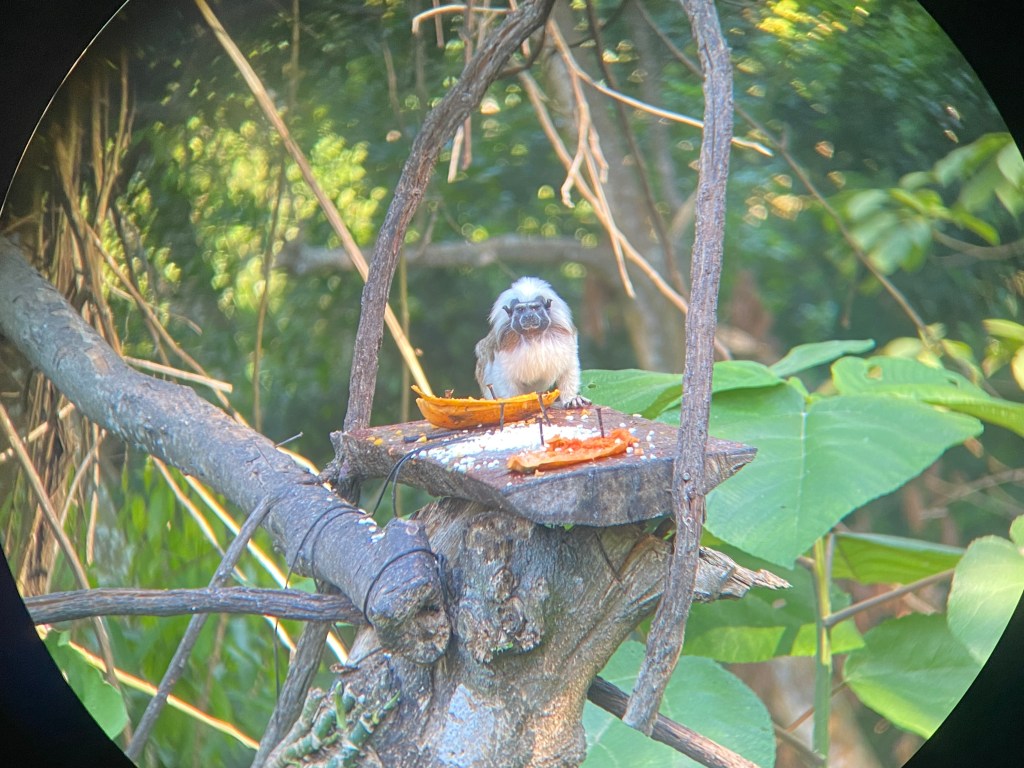
The green, camouflage netting sways gently in the breeze. We peek out from under it, our eyes trying to spot the miniature monkey hopping through the dense canopy towards the smashed papayas and bananas lying out for the birds. A white crest of hair peeks out from behind a leaf, followed by a brown and white body. A bird sings off in the distance. Cautiously, the tamarin creeps down the branch, its tiny claws gripping the bark, its tail swishing. It stops. It takes a small bite of fruit. The monkey clearly knows we’re watching, but it doesn’t seem bothered. For half an hour, we track its every move. When it’s finally full, it turns away, sparing us one last glance. A rustle, then it bounds back into the trees.
Endemic to northwestern Colombia, the critically endangered Cotton-top tamarin lives in a limited jungle habitat near the Caribbean Sea. As one of the smallest monkeys, they’re only 17-19 inches long, with their tail included. They spend most of their lives in the forest canopy, eating fruit and insects. They are highly social and territorial, living and sleeping in small family groups of about 3 to 15 monkeys. They are one of the most endangered primates in the world, with approximately 6,000 left in the wild. This is mainly due to deforestation, the illegal pet trade, and, most shocking, in the mid 1900’s almost 30,000 were exported to the US for biomedical research.
It’s hard knowing that these amazing creatures can’t stand up for themselves against our modern world. I guess this post is my way of trying to give voice to their story or at least what I’ve interpreted of it, but I know I can never speak for them. I can only give my blessings, and hope that they find a way to live for as long as we do.
 Bueno Ramro
Leave a comment