by Tim
The world’s most iconic landscapes and ecologies are still thankfully inhabited by vernacular cultures. Humans continue to follow caribou migrations in the arctic north, or to build villages from the Amazon forest and then let them decompose entirely within a few years. Many folks still know the prayers and offerings to the Andean peaks and where to plant that specific variety of potato at 15,000 feet. Himalayan villagers continue tending ancient terraces and foraging in nearby forests. These things are still happening, even as modernity violently flattens culture everywhere.
These original people know the curves and textures of the land as it weaves around and within them in an intraconnected fabric. Humans have lived in every nook of the Himalayas with the exception of the highest altitudes. Why humans decided that the Tibetan plateau was the place to be, or on the side of a nearly vertical jungle slope in the middle hills, as opposed to down low in the flat, fertile subtropical Gangetic plains I cannot say. It is far more difficult to live up there in nearly every way. I don’t think it can be explained away as “that’s where the trading routes ran”, or because of a scarcity of land elsewhere, or being pushed there by the dominant groups from India, though these things definitely play a role and are likely the accepted academic reasons. Yet it must also be something deeper. It is the same impulse that moved humans to inhabit literally every other piece of land, now including Antarctica. Is this not actually life itself wanting to move and take root in new places, from seeds to spores to geese? Early humans in the Himalayas probably also were drawn to the views, the air, the big skies, and the awe. The places themselves most definitely exerted their inherent pull, then as now.
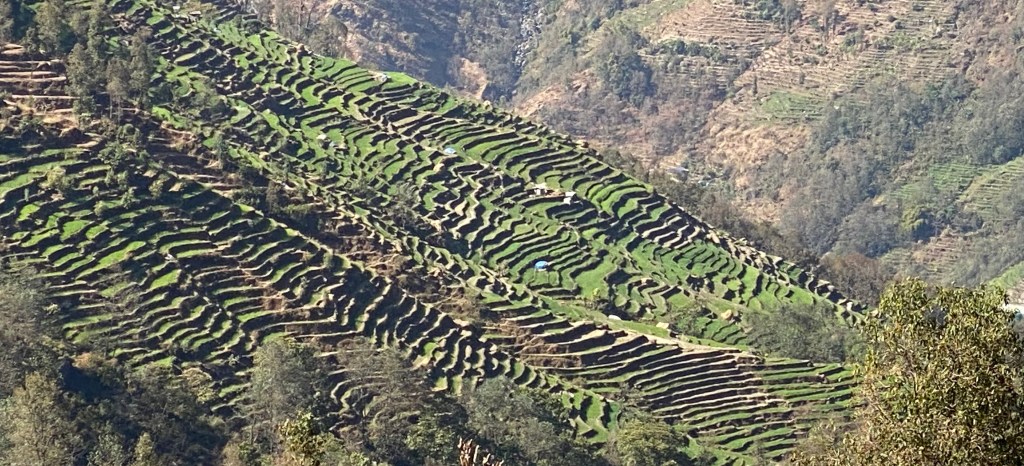
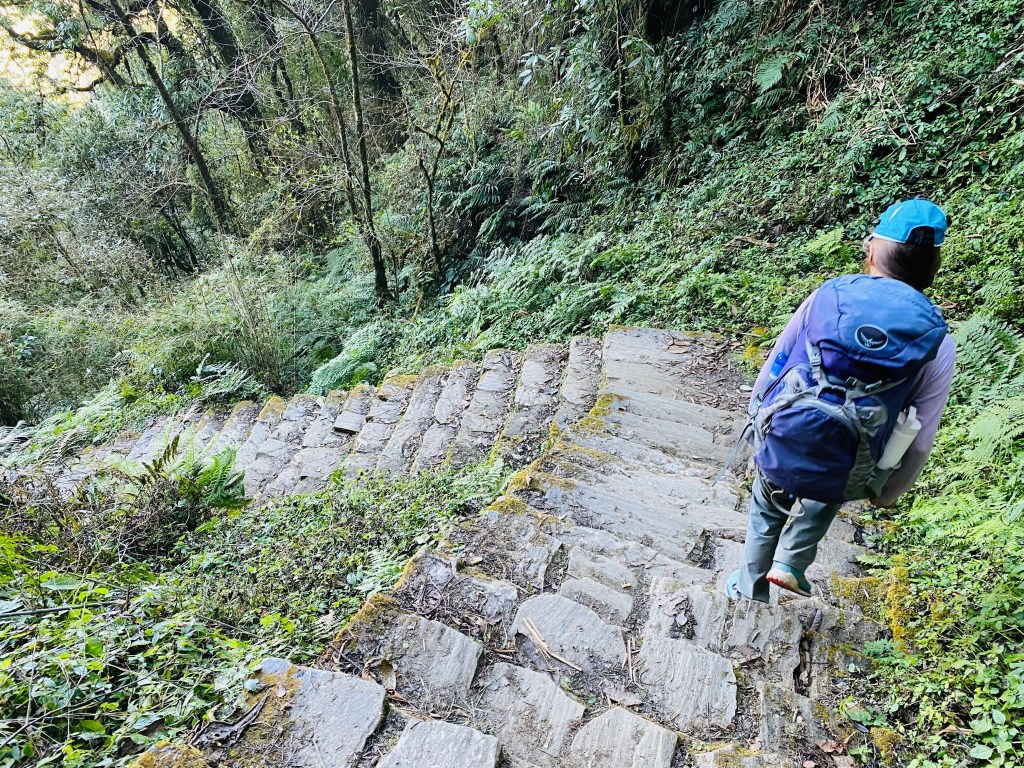
The Himalayas have pull. And push. You can feel the mass of earth beneath you, heaving, pressing skyward; so much earth rammed into these peaks and folds. Geology and elements constantly re-shape these peaks. So do humans. They pull rocks up from the earth, crush them, split them, and make them into roofs, stairs, roads, walls, and terraces. The terraces alone have the impact of glaciers, terraforming entire hillsides into steps for giants. And holding in soil for food. Breathtaking to view. Buffalo and oxen are yoked and make miniature laps with plows. The plowman skating along behind – one foot on, one foot off, shouting, yipping, yelling, slapping. Earth turned over, again and again for a new season. Buffalo dung tilled back into the fields.
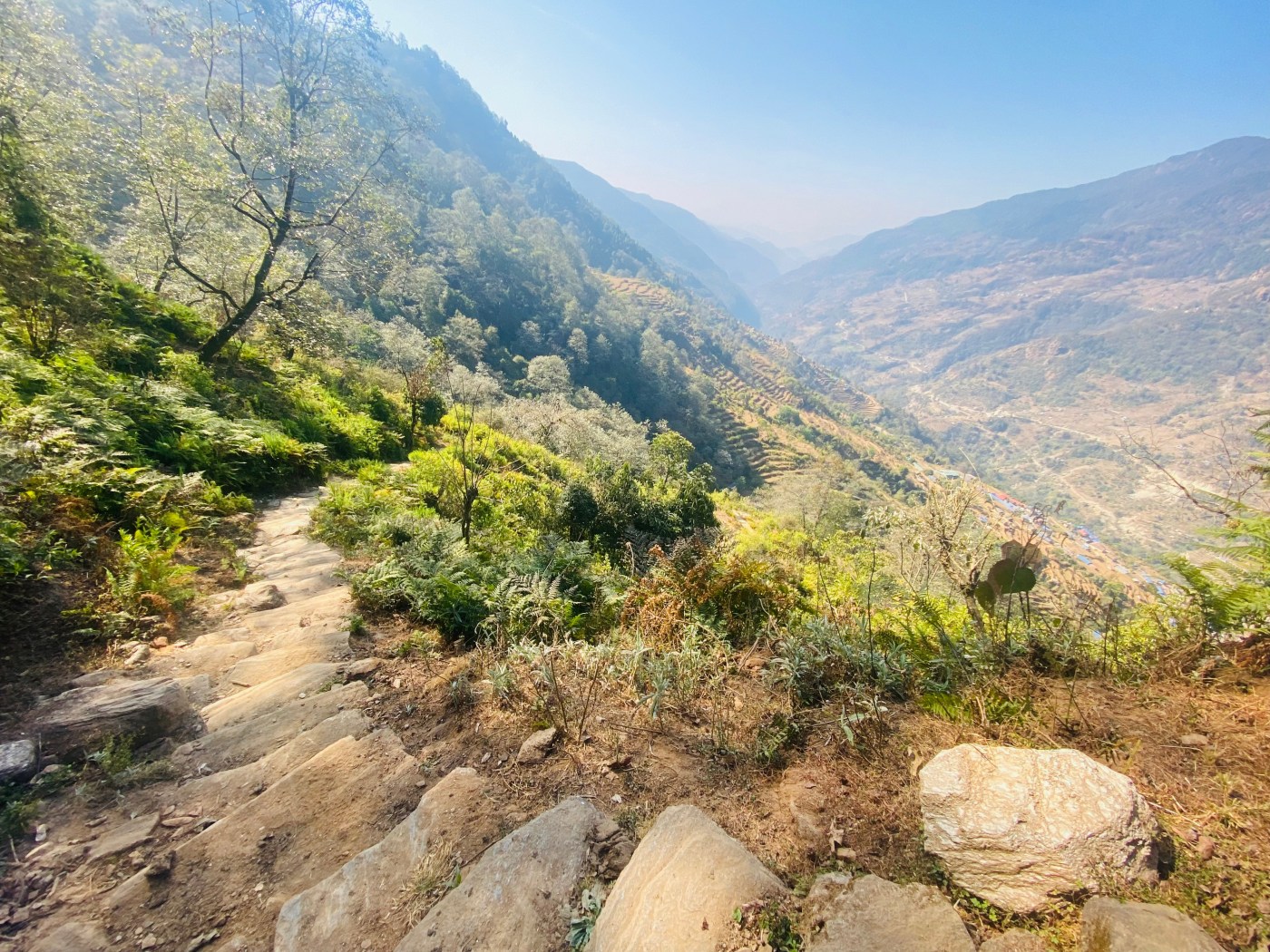
The trails are wonders of engineering and endurance. I remember being schooled by a Peruvian friend once when I marveled at how perfectly the stones fit together in Cuzco (as everyone does). “How did they do that?” He looked at me sharply and gave me the best response I’ve ever heard. “Because they loved the stone.” Step after step on our first trek here we wondered how these trails were built, when, and by whom? The how may be as simple as “because they love the stone, and the mountains.” And because they need roads. The who became clear as we passed trail crews, mostly men, heaving stones out of the jungle, or quarrying out of alpine bedrock, smashing them, and then setting. They get paid once the work is done, equivalent to about 5 dollars a day. Same as it ever was.
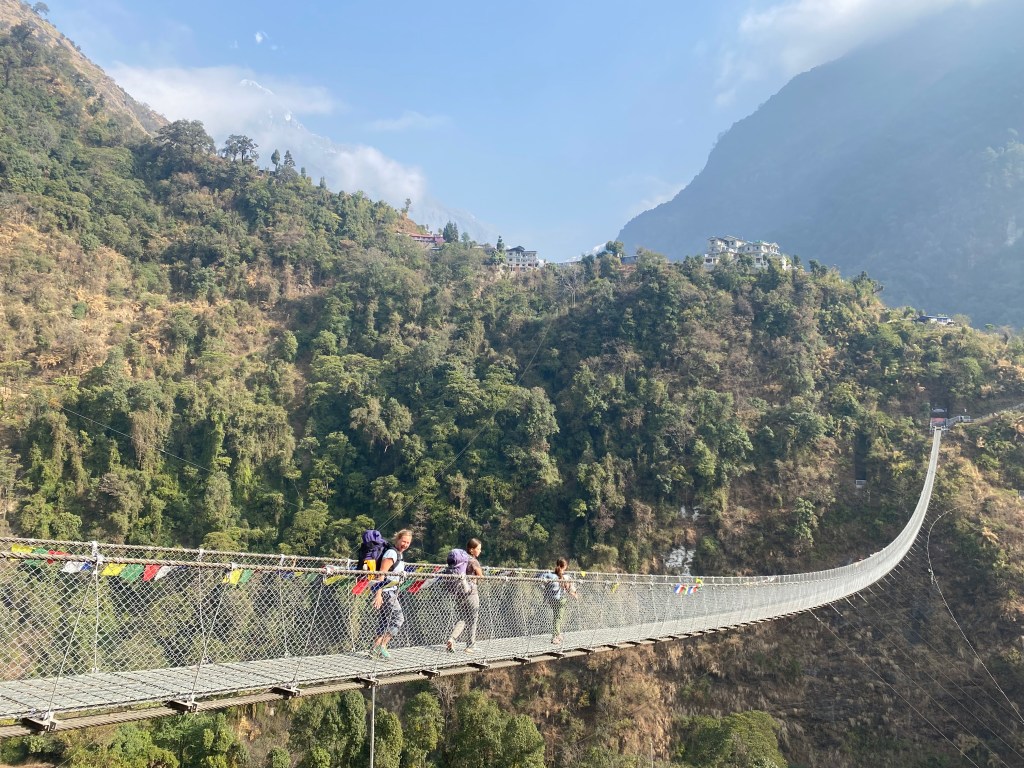
We came upon another road being built. This road’s team consisted of around 5 men and one Hitachi excavator. They were carving a road up the Modi Khola valley at an alarming rate, tearing up the old stone trails and big trees, setting the stage for landslides to cause further wreckage. This particular project was an access road for a hydropower plant right at the uppermost constriction of the canyon. We watched “development” unfold in real time. The most memorable night and afternoon we spent on the entire trek was with a Gurung family in Himalpani, along the road’s path; they were still thriving in traditional ways with water buffalo, rice, vegetables all cultivated locally. Small kids, new parents, and elders in one home. A waterfall poured from above and the blue Modi Khola tumbled below while Annapurna South loomed 20,000 feet above. Langur, bear, and leopard are known forest residents. It may be the most perfect representation of paradise on earth. We learned that the family had already sold their land to the hydropower project and the road likely is tearing through this land as I write this, one week later. The family is moving to the city.
Now, how to wrap this piece up? I’m really not sure. My mind has been like a Himalayan cloud, in writing here, taking ephemeral forms and then disappearing when attempting to grasp. But maybe by going back to the point about knowing how to act and create improbable beauty once we have love. We know how to work with stones when we love stones. We know how to honor places when we have love for them in our hearts. So I’ll end with a dedication to Tom Robbins in this vein, who recently passed through the veil, perhaps having finally found for that fabled Tibetan Peach Pie.
“The highest function of love is that it makes the loved one a unique and irreplaceable being.”
― Tom Robbins, Jitterbug Perfume
 Bueno Ramro
Leave a comment