by Tim
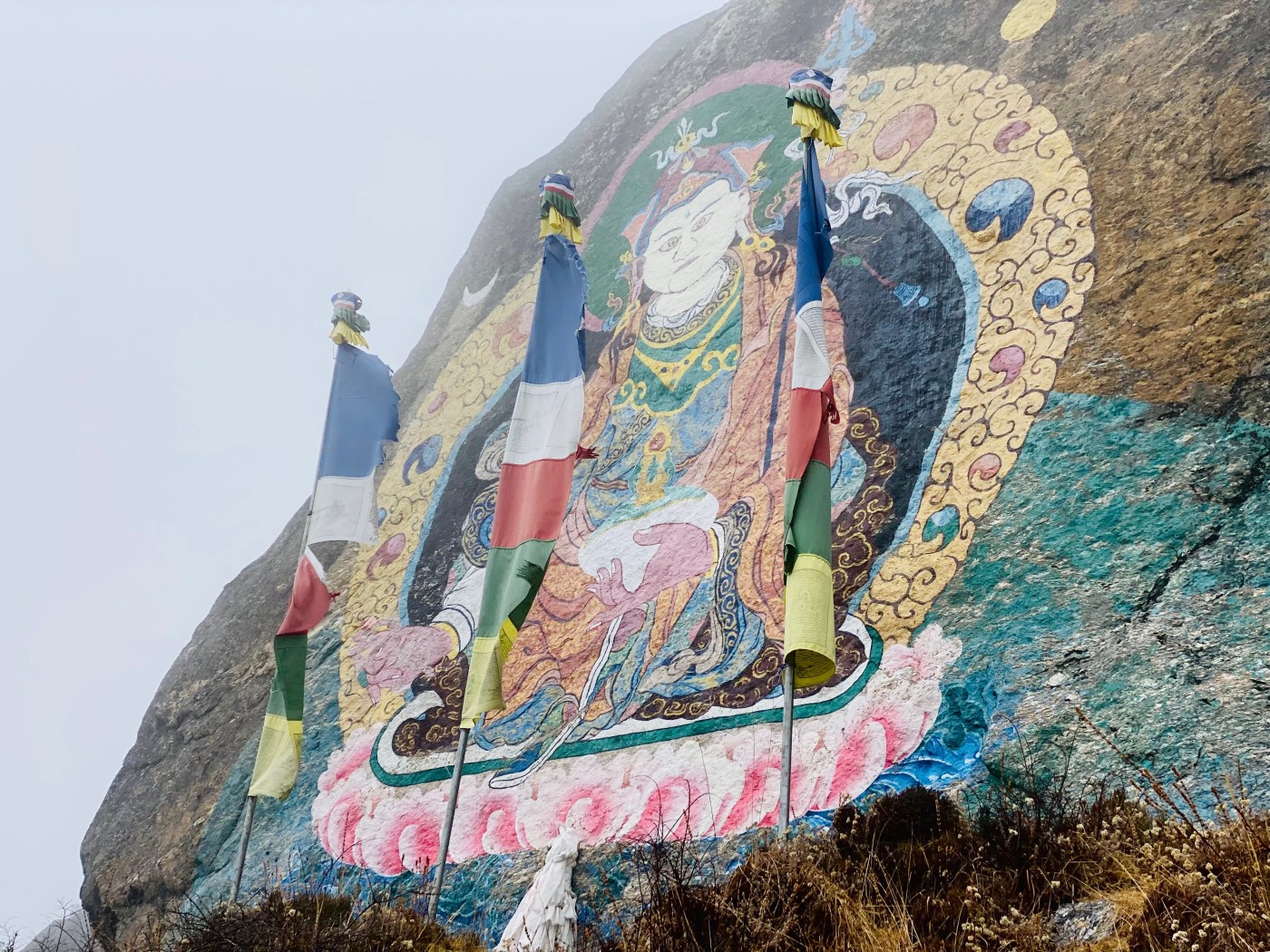
Situated on the top of the world, let’s imagine the Himalayas to be the Earth’s head. Inside that head is the world’s brain or, more accurately, its mind-body. Cut into this earthly mind-body are countless caves where mystics have entered to explore consciousness for thousands of years. The fantastical Bodhisattva (enlightened one) Milarepa spent much of his life, whether in fact or in myth, in retreat in these portals. The upper Rolwaling Valley is known for the rich presence of such legendary grottos. On a misty rest day at our highest camp in Na, I made my way up to one them, named for Guru Rinpoche, the mustached bodhisattva also known as Padmasambava, credited with bringing Buddhism to Tibet. A painting of him adorns the rock near a shuttered monastery below the cave.
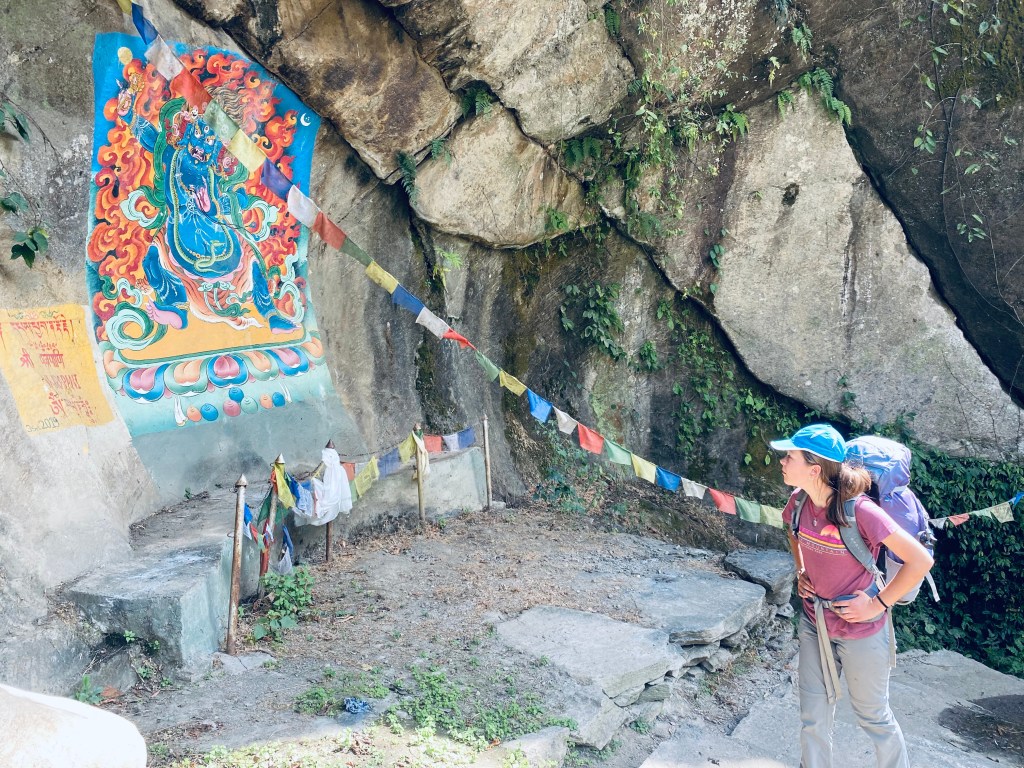
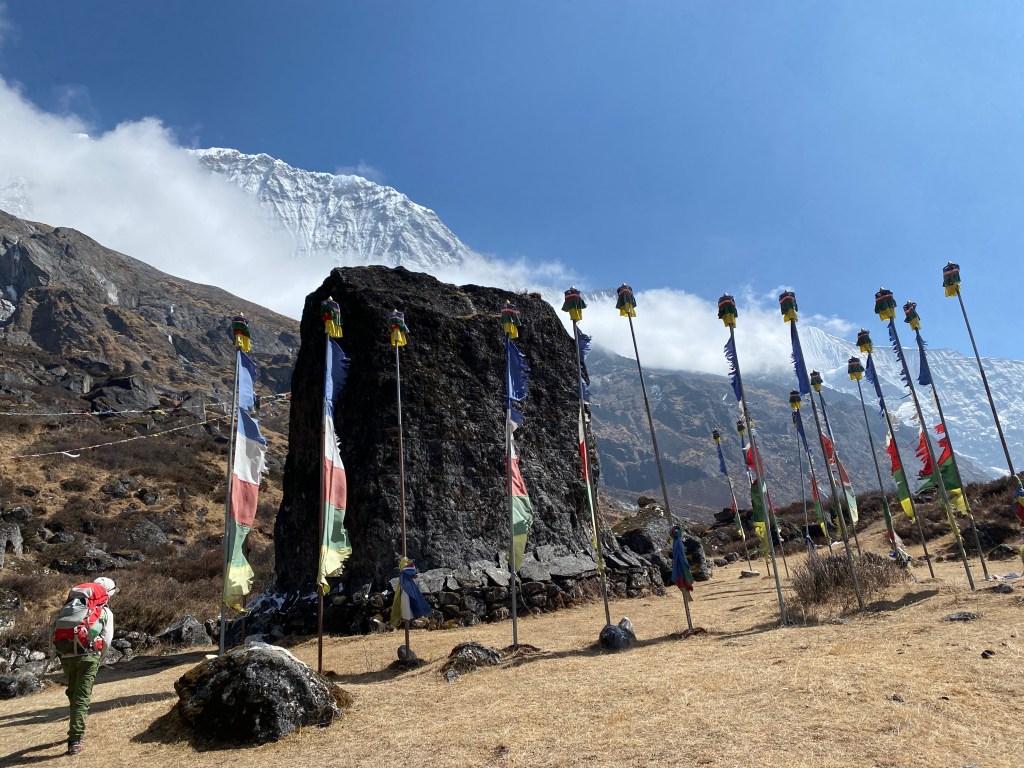
Caves, like mountain summits, or thick forests, are understood differently by different cultures. How, when, or whether to enter into the earth, stand on a mountain summit, or wander into the deepest forest are some of the oldest concerns of animate cultures. From what I’ve learned, there is no universal agreement. Regardless of whether demon spirits guard them and they should be avoided or enlightenment can be found by spending sufficient time in them, caves are always seen as unique places of power. I consider this as I approach, barely able to see the stone steps in front of me, passing prayer flags and mani (painted prayer walls). I wonder whether I am approaching with only a passing curiosity or a sincere intention for deep insight. How many people, these days, have the patience for insight of this sort? The kind of patience and discipline that allows an initiate to enter a cave with no exit strategy, no schedule, nowhere else to be. No need to tell others about it. I even wonder how many monks have that kind of patience these days, to be able to set aside modern day obligations or enticements in order to simply be in a mountain cave for as long as it takes.
The cave emerges from the fog like a dragon’s mouth, prayer flags curiously appearing as teeth. I say my prayers as well as I know how. The seeping water is frozen this time of year, and I’m able to pass ice flows and boulders as I make my way to the back of the cave. The furthest back, where the cave’s opening appears like a sliver. Here is where the mystics must have sat. How many hundreds of them over the years? There is something unimaginably powerful in sitting on that seat, where so many important transmissions have passed. Inside the cave, the outside is easily forgotten. The Earth’s mind-body has its way with things and quickly gets to work. Politics, activism, schedules, anxieties, forward projections, relationships, are consumed in the mass of these mountains, integrated into her earthly nervous system.
As the afternoon passes, where else can I go now but back down the mountain? There is still life to be lived, even as the call of transcendence echoes from the cave.
 Bueno Ramro
Leave a comment